Political Transformations in the Interwar Period: The Case of Slovenian Political Thought
Ključne besede:
politična zgodovina, Slovenija, medvojno obdobjeKratka vsebina
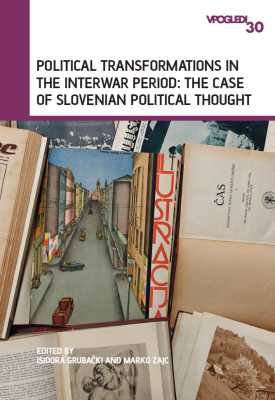
Political Transformations in the Interwar Period: The Case of Slovenian Political Thought, edited by Isidora Grubački and Marko Zajc, is a scholarly reader produced within the Political History Program at the Institute of Contemporary History in Ljubljana. The volume presents English translations of sixteen primary sources of Slovenian political thought from the interwar period, selected by nine contributing authors. Each source is accompanied by a biographical note on the author and a contextual introduction situating the text within its historical, political, and intellectual setting.
The reader grew out of a collaborative workshop held in Ljubljana in April 2024, where specialists in the history of political thought in East Central Europe discussed possible source selections and their broader relevance. Rather than offering a comprehensive overview, the editors explicitly aimed to move beyond a simplified historiographic division of interwar Slovenian political thought into Catholic, liberal, and Marxist camps. Contributors were encouraged to contextualize the selected texts within wider Yugoslav and transnational frameworks and to reflect current research interests in the field. The resulting selection highlights political thought as a dynamic response to profound transformations brought about by the collapse of empires, the formation of new states, and the crisis of liberal parliamentary systems in the interwar years. The volume also reflects recent methodological trends, including an expanded definition of political thought, a broader range of source types, and attention to themes that have previously received limited attention in Slovenian national historiography.
The sixteen annotated primary sources together map the diversity of Slovenian political thought in the interwar period and its entanglement with Yugoslav and transnational debates. The selection spans agrarian, socialist, communist, liberal, republican, Catholic, and feminist traditions, addressing central themes such as the agrarian and social questions (Jože Srebrnič, Dragotin Godina), republicanism and socialism (Albin Prepeluh, Etbin Kristan), and competing interpretations of the national and Yugoslav questions (Albert Hlebec, Ljubomir Dušanov Jurković, Andrej Uršič, Josip Vilfan). Several contributions foreground leftist and Popular Front contexts, including communist and left-Catholic engagements with nationalism and international politics (Angela Vode, Leopoldina Kos, Edvard Kocbek), while others broaden the scope of political thought through cultural, bodily, and gendered perspectives, such as Zofka Kveder’s Yugoslavist literary intervention, Viktor Murnik’s reflections on physical culture, and Minka Govekar’s feminist analysis of housework.
Dr Maria Falina emphasizes the accessibility and research value of the reader, observing that it “introduces important texts to the reading public and makes them accessible not only through translation, but also by placing them in historical context and by providing short intellectual biography sketches of the authors.” She further praises the editors’ introduction as offering “an original and very convincing framing of how ‘national’ political thought can be conceptualised,” and welcomes the volume’s expanded approach to political thought, which she describes as “a model of how sources for political thought can be approached and analysed.”
In Dr Marco Bresciani’s assessment, “perhaps the most important scientific achievement of this volume concerns the crucial link, which has been carefully investigated, between the contingent, situational transformation of political and geopolitical contexts, both regional and international, and the development of an ever-evolving political thought.” He also highlights the value of the essays that shed new light on key interwar debates, noting their contribution to understanding issues such as “the ‘women’s issue’, the ‘minority issue’, the ‘social issue’ and the ‘national issue’.”
Poglavja
-
Foreword
-
Introduction: Toward a New History of Interwar Slovenian Political Thought
-
JOŽE SREBRNIČ: On the Agrarian Theses
-
ZOFKA KVEDER (AS DIMITRIJE GVOZDANOVIĆ): The Grandson of Prince Marko
-
Newspaper Discussion in Orjuna and Glas Svobode before the Confrontation in Trbovlje on 1 June 1924
-
ALBIN PREPELUH: Why Are We Republicans?
-
DRAGOTIN GODINA: Exchange Cooperatives Will Free Us from the Slavery of Money and Capital
-
LJUBOMIR DUŠANOV JURKOVIĆ: The Question of Yugoslavism
-
ALBERT HLEBEC: On the Slovenian National Question
-
VIKTOR MURNIK: Culture and Physical Exercise
-
ANGELA VODE: The Woman Question
-
LEOPOLDINA KOS: Feminism and the Struggle of the Working Woman
-
ETBIN KRISTAN: Un-American Socialism
-
MINKA GOVEKAR: The Value of Housework
-
JOSIP VILFAN (WILFAN), The Congress of European Nationalities and the Peace Problem
-
EDVARD KOCBEK: A Reflection on Spain
-
ANDREJ GOSAR: The Woman Question
-
ANDREJ URŠIČ: The Yugoslav Youth and the Cvetković–Maček Agreement
Prenosi
Izdano
Zbirka
Tiskane izdaje ISSN
Licenca

To delo je licencirano pod Creative Commons Priznanje avtorstva-Nekomercialno-Brez predelav 4.0 mednarodno licenco.